This was not a warehouse problem. It was a problem of kitting rules never agreed between four functions — planning, purchasing, warehouse and assembly. Cash sat in the warehouse while the line waited for parts; sales chased planning, and planning chased purchasing.
The problem
- Sales and operations planning (PSI) was unclear. There was no agreed rule for how forecasts and firm orders entered the monthly plan, and planning batches did not line up with customer demand.
- MRP ran too coarsely. Once a month, on a three-month forecast, with every material on the same replenishment rule and no segmentation by material characteristics.
- Nothing controlled goods in transit. Once purchase orders were issued, nobody could say how much was on its way or when it would arrive; open orders piled up.
- Neither assembly nor despatch was kitted. The warehouse held stock, but when a work order started, parts were missing; finished goods could not ship and lead time stretched to three months.
What we looked at first
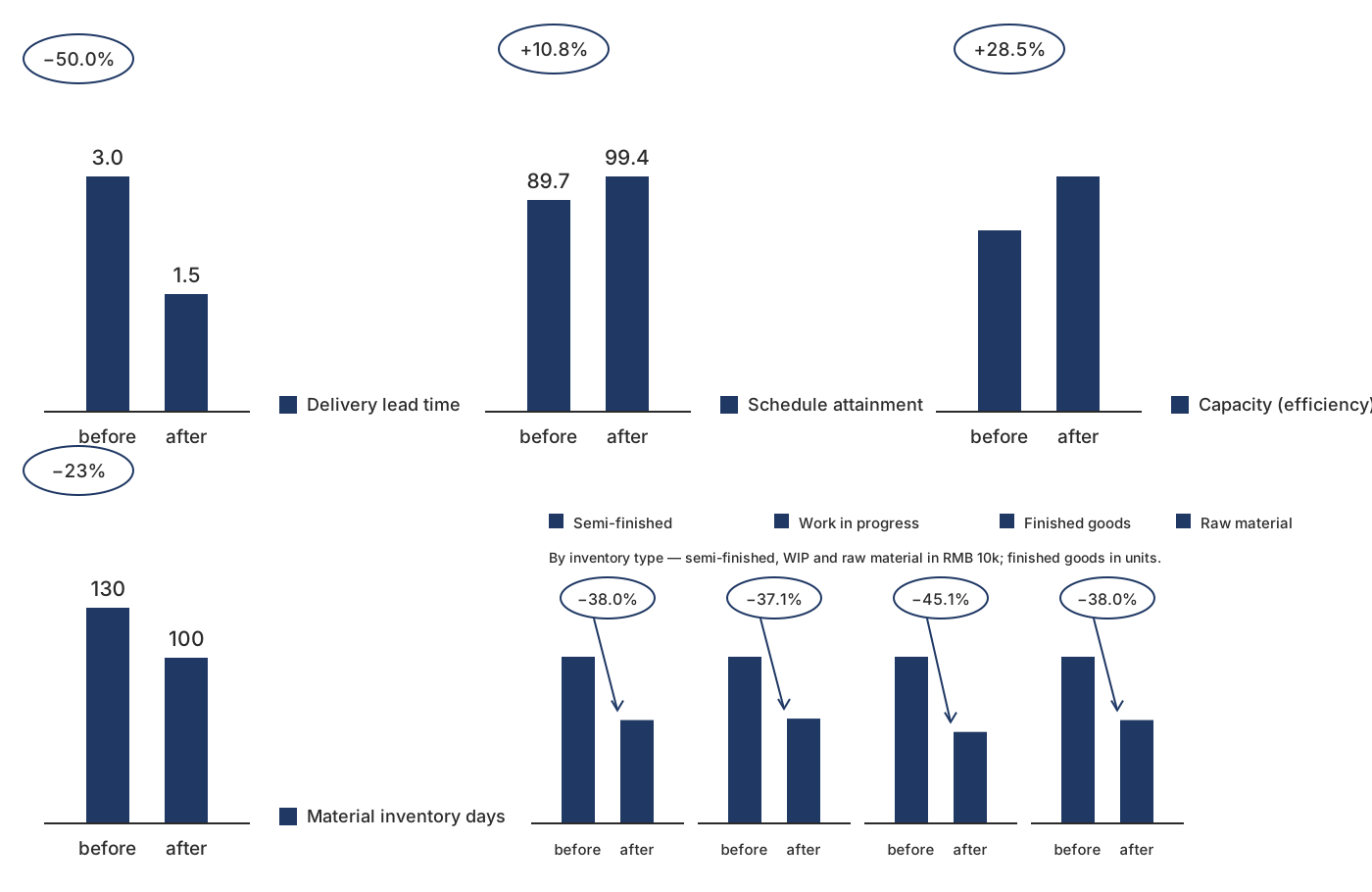
We did not start with software. We took one real order and walked it end to end — order entry, the S&OP meeting, MRP, purchasing, goods receipt, assembly, despatch — to see where it stopped and for how long. Then we looked at four numbers: lead time, schedule attainment, days of material inventory and kit readiness.
The walk made it clear: the problem sat in no single department. It sat along the chain from forecast to plan to purchase to kit, where each stage ran to its own rhythm and nobody owned the final delivery date.
What we did
- Set finished-goods inventory policy. Which products to stock and how much, derived from delivery promises and demand variability instead of judgement.
- Rebuilt PSI. Forecast plus firm orders into the monthly plan, rolled weekly; planning batches aligned with customer demand.
- Fixed MRP and master data. Completed the material parameters so the system calculated net requirements rather than gross; MRP then ran weekly, not monthly.
- Segmented replenishment. ABC-XYZ split: stable-consumption items on stock and Min-Max, the rest by MRP, instead of one rule for everything.
- WIP buffer and kitting. A kit check before assembly so shortages surfaced early; buffers on critical materials, with purchasing watching red and amber only.
- A low-code tool. Supplier and material status on one platform, so purchasing could see goods in transit and suppliers could update progress.
Results
Who this is for
- Discrete assembly plants with high-mix, low-volume production, multi-level BOMs and frequent shortages before assembly.
- Companies that have ERP but cannot make MRP work; planning still runs on spreadsheets and manual shortage checks.
- High inventory and long lead times, with sales, planning and purchasing chasing each other every day.
- Not for: single-product, high-volume plants, or process industries (chemicals, food, pharmaceutical ingredients).
Walk one order before deciding what to do
A two-day on-site diagnostic: take one real order through planning, purchasing, warehouse and assembly, find five breakpoints and leave a 90-day roadmap. No software pitch, no large programme.
Austin Zhai | Plan · Kit · Deliver zhaiweidong.com austin.zhai@hotmail.com